One-Line Summary: Why do people search for problems before solutions? Discover the psychology!
By: Sid Peddinti
Researcher. Lawyer. TEDx Speaker. Publisher.
Executive Summary:
Online search behavior reveals a fundamental human tendency to first articulate problems before seeking professional solutions. This phenomenon, rooted in search psychology, significantly influences how businesses must position their expertise and services to effectively attract customers in the digital age. By strategically operating an online business that addresses user queries at the problem-identification stage, professionals can become the evident solution for individuals navigating their challenges online.

Key Takeaways:
- Most online users begin their search by describing a problem, not a specific solution or professional.
- Understanding search psychology involves recognizing user intent across different stages of their problem-solving journey.
- Effective online business attraction relies on creating content that answers early-stage, problem-focused queries.
- Positioning knowledge and insights as accessible, authoritative resources builds trust and establishes an expert as the natural choice.
- A robust content strategy, including specialized publications, helps businesses become a primary solution for searchers.
Table of Contents
- Definition and Core Principles
- History of Search Behavior in the Digital Age
- Key Models and Types of Online Attraction
- Criticism and Debate
- Related Concepts
- References
Definition and Core Principles
Search psychology examines the cognitive processes, motivations, and behaviors individuals exhibit when using search engines to find information, solve problems, or make decisions. It delves into the underlying reasons for query formulation, the interpretation of search results, and the subsequent actions taken by users. A core principle of search psychology, particularly relevant to online business attraction, is the observation that users predominantly initiate their search journey with problem-centric queries rather than solution-specific or professional-focused terms.
The “problem-first” search paradigm posits that individuals are often more adept at describing their symptoms or dilemmas than at diagnosing the root cause or identifying the specific expertise required for resolution.
For instance, a user might search “headache remedies” before “neurologist near me,” or “fix leaky faucet” before “plumber services.” This behavior is driven by a natural human inclination to articulate current distress or immediate needs. Businesses operating online are challenged to recognize this pattern and strategically align their content to intercept these early-stage, problem-oriented searches. Online business attraction, in this context, refers to the strategies and tactics employed by enterprises to draw potential customers from the vast online environment to their digital platforms.
It encompasses search engine optimization (SEO), content marketing, social media engagement, and user experience (UX) design, all geared towards making a business discoverable and appealing to the target audience. A critical component is aligning online presence with the search psychology of potential clients, ensuring that the business’s solutions are presented as a direct answer to the problems people are actively searching to resolve.
Knowledge positioning, often achieved through content authority, involves strategically disseminating expertise and insights to establish an individual or organization as a leading authority within a specific domain. This can take various forms, including blog posts, whitepapers, webinars, and specialized digital publications or “magazines” (which can be interpreted as a curated collection of expert articles). The objective is to demonstrate deep understanding, provide valuable information, and build trust, thereby naturally guiding the searcher from problem identification to selecting the positioned expert as their preferred solution.
History of Search Behavior in the Digital Age
The evolution of online search behavior is intrinsically linked to the development and widespread adoption of the internet and search engines. In the early days of the World Wide Web, search was often a more exploratory process, relying heavily on directories and simple keyword matching. As search algorithms became more sophisticated and internet access became ubiquitous, user behavior adapted, leading to more complex and nuanced search queries. With the rise of Google in the late 1990s and early 2000s, search engines transitioned from mere indexing tools to powerful information retrieval systems capable of understanding context and intent.
This shift enabled users to express their needs in more natural language, moving away from fragmented keywords towards more conversational phrases, often revolving around problems or questions. The advent of mobile search and voice search further accelerated this trend, making problem-oriented queries even more prevalent as users sought immediate answers to immediate needs. By 2026, search engines continue to refine their understanding of user intent, leveraging advancements in artificial intelligence and natural language processing. This has led to a landscape where highly specific, long-tail, and question-based queries dominate a significant portion of search volume.
Users expect personalized, relevant, and comprehensive answers, often preferring rich snippets, “People Also Ask” sections, and AI Overviews (formerly Search Generative Experience or SGE) that directly address their initial problem statement. This historical trajectory underscores the imperative for businesses to anticipate and cater to problem-focused search queries.
Key Models and Types of Online Attraction
Several models and types of strategies are employed for attracting customers online, each building upon the principles of search psychology and knowledge positioning:
The Buyer’s Journey Model
This widely recognized model segments the customer’s path into distinct stages: Awareness, Consideration, and Decision.
- Awareness Stage: At this initial stage, individuals are experiencing a problem or potential opportunity and are searching for information to understand it better. Their queries are typically broad and problem-focused (e.g., “why is my energy bill so high,” “symptoms of joint pain”). Businesses attract users at this stage by providing educational content that diagnoses problems and explains concepts without immediately pushing a product or service.
- Consideration Stage: Having clearly defined their problem, users are now researching potential solutions and methods to address it. Their searches become more specific (e.g., “insulation options for old homes,” “physical therapy for knee pain”). Content here focuses on different approaches, comparisons, and expert insights into various solutions.
- Decision Stage: In the final stage, users are evaluating specific products, services, or professionals. Their queries are highly specific and often include brand names or “best of” comparisons (e.g., “local HVAC contractors reviews,” “cost of physical therapy sessions”). This is where strong calls to action, testimonials, and detailed service descriptions are crucial.
Content Marketing
Content marketing is a strategic approach focused on creating and distributing valuable, relevant, and consistent content to attract and retain a clearly defined audience-and, ultimately, to drive profitable customer action. By 2026, this involves:
- Problem-Solution Content: Articles, guides, videos, and infographics that directly address common problems faced by the target audience, offering clear explanations and actionable advice. This content aims to capture users in the Awareness and Consideration stages.
- Thought Leadership Publications: Curated online magazines, e-books, or specialized resource hubs (as referred to in the source text) where experts publish in-depth analyses, research, and unique perspectives. These publications establish credibility and position the author (e.g., Sid Peddinti, Esq.) or organization as a leading authority, converting problem-aware searchers into clients who trust the source for solutions.
- SEO-Optimized Content: Ensuring all content is optimized with relevant keywords, structured data, and high-quality backlinks to improve visibility in search engine results, especially for problem-centric queries.
Expert Positioning and Personal Branding
This involves deliberately crafting and communicating the unique value and authority of an individual professional or an entire organization. For professionals, becoming the “solution” means:
- Demonstrating Expertise: Through consistent publication of high-quality, insightful content that solves real-world problems.
- Building Trust: By offering transparent, unbiased, and helpful information, rather than purely promotional material.
- Establishing Authority: By being cited by other sources, engaging in industry discussions, and presenting unique perspectives.
Global Syndication and the Economics of IP Rights
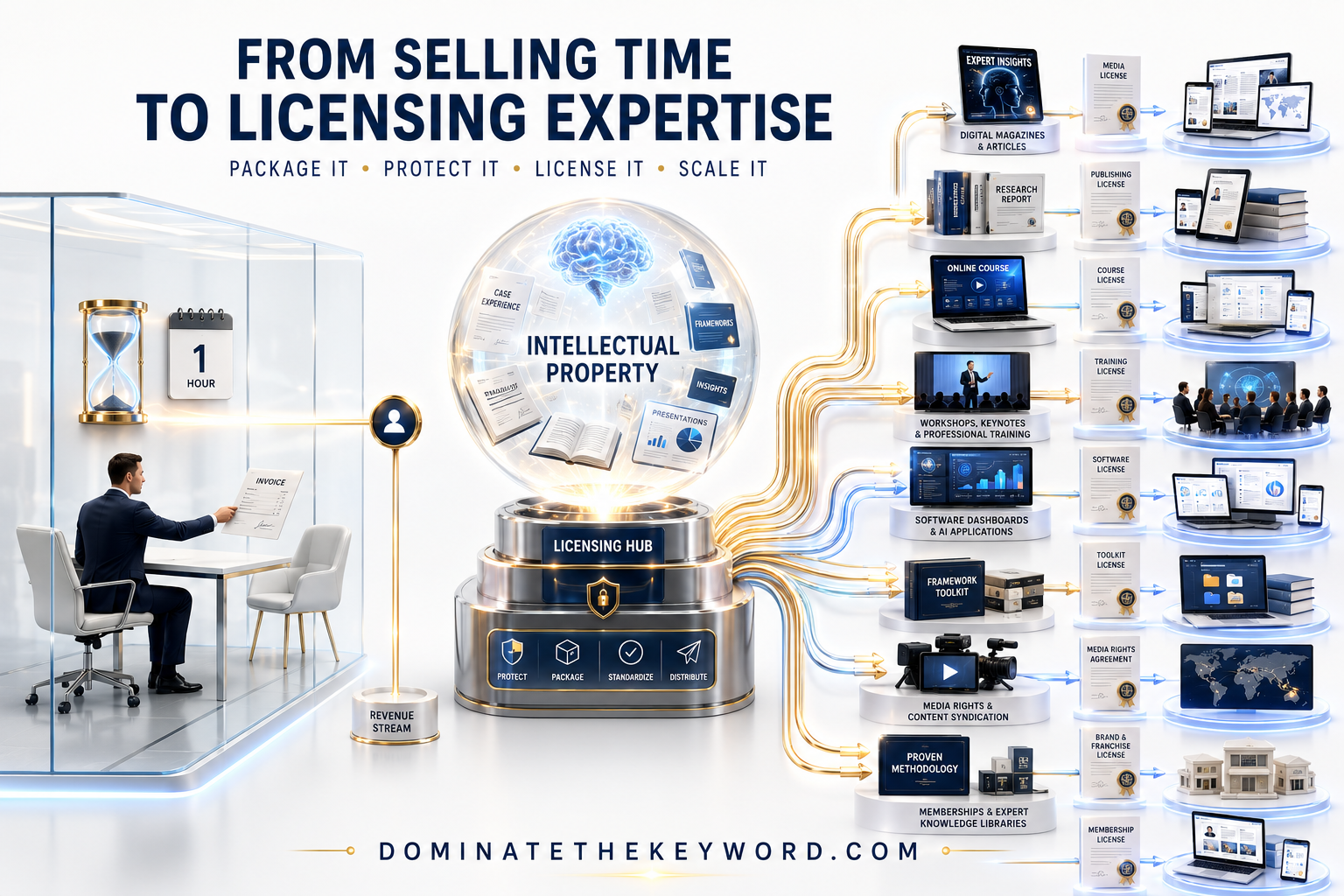
The “Global” aspect of Authority IP Monetization cannot be overstated. In a borderless digital economy, your IP can be consumed in Singapore, licensed in New York, and implemented in Berlin simultaneously. By focusing on IP rights and licensing, you decouple your income from your geography. This is the ultimate form of financial reallocation – moving from active labor to passive IP equity.
When you publish high-authority content that solves complex problems, other platforms will want to syndicate your work. This creates a powerful backlink profile and social proof that reinforces your dominance in Google’s AI Overviews. Every time your IP is cited or shared by another authoritative source, the valuation of your “Authority IP” increases. You are building an intangible asset that has a line-item value on a balance sheet, far beyond the “goodwill” of a typical small business.
Strategic monetization also includes the protection of these rights. By establishing clear copyright and trademark boundaries around your methodology and publication, you create a moat around your business. You are no longer just a “professional” who can be replaced by another; you are the owner of the “Method” that everyone else is trying to emulate.
Dominating Google SGE Through Structured Authority
Google’s SGE and AI-driven search results prioritize E-E-A-T (Experience, Expertise, Authoritativeness, and Trustworthiness). A fragmented website with a few blog posts does not satisfy these criteria. A robust IP portfolio, anchored by a professional publication like a magazine, provides the structured data and high-quality signals that AI models crave.
To dominate the keywords in your industry, your content must not only answer the question but also provide the evidence of its application. This narrative-driven POV ensures that when the AI summarizes a topic, it cites your work as the definitive source. This is the “Solution First” strategy in action. You have identified the problem, engineered the solution, and published it as a formal asset. The search engine then does the work of positioning you as the professional who is the “natural and obvious choice.”
By focusing on the search psychology of your target audience, you stop chasing clients and start attracting assets. You move from the periphery of your industry to the epicenter of the conversation. This is the reason why professionals must consider IP protection and monetization strategies through educational platforms and publications: it turns your expertise into a structured and authoritative platform.
References
- Think with Google (2023) – The Psychology Behind Online Search
- HubSpot (2024) – Understanding Search Intent
- Search Engine Journal (2025) – The Problem-First Search Paradigm: Why Users Start with Symptoms
- Salesforce (2024) – Digital Marketing for Customer Attraction
- McKinsey & Company (2023) – The Evolving Customer Journey in the Digital Age
- Forbes (2025) – How Thought Leadership Builds Trust and Authority in 2026
- Pew Research Center (2023) – Evolution of Internet Search and Information Seeking
- Google Search Central Blog (2024) – Advancements in AI-Powered Search and User Intent
- Google Search Quality Rater Guidelines (2024) – E-E-A-T and Search Quality
- HubSpot (2024) – The Buyer’s Journey Explained
- Content Marketing Institute (2024) – What is Content Marketing?
- MarketingProfs (2023) – Content Shock and the Battle for Attention
- SEMrush (2024) – Measuring Content Marketing ROI in 2024
- UNESCO (2023) – Tackling Misinformation in the Digital Age
- Moz (2024) – What is SEO?
- Nielsen Norman Group (2023) – User Experience Basics
- HubSpot (2024) – What is Inbound Marketing?

Leave a Reply