By: Sid Peddinti, Esq. | Legal Innovator. Lawyer. Researcher. Publisher.
Hey Law Firm Owners,
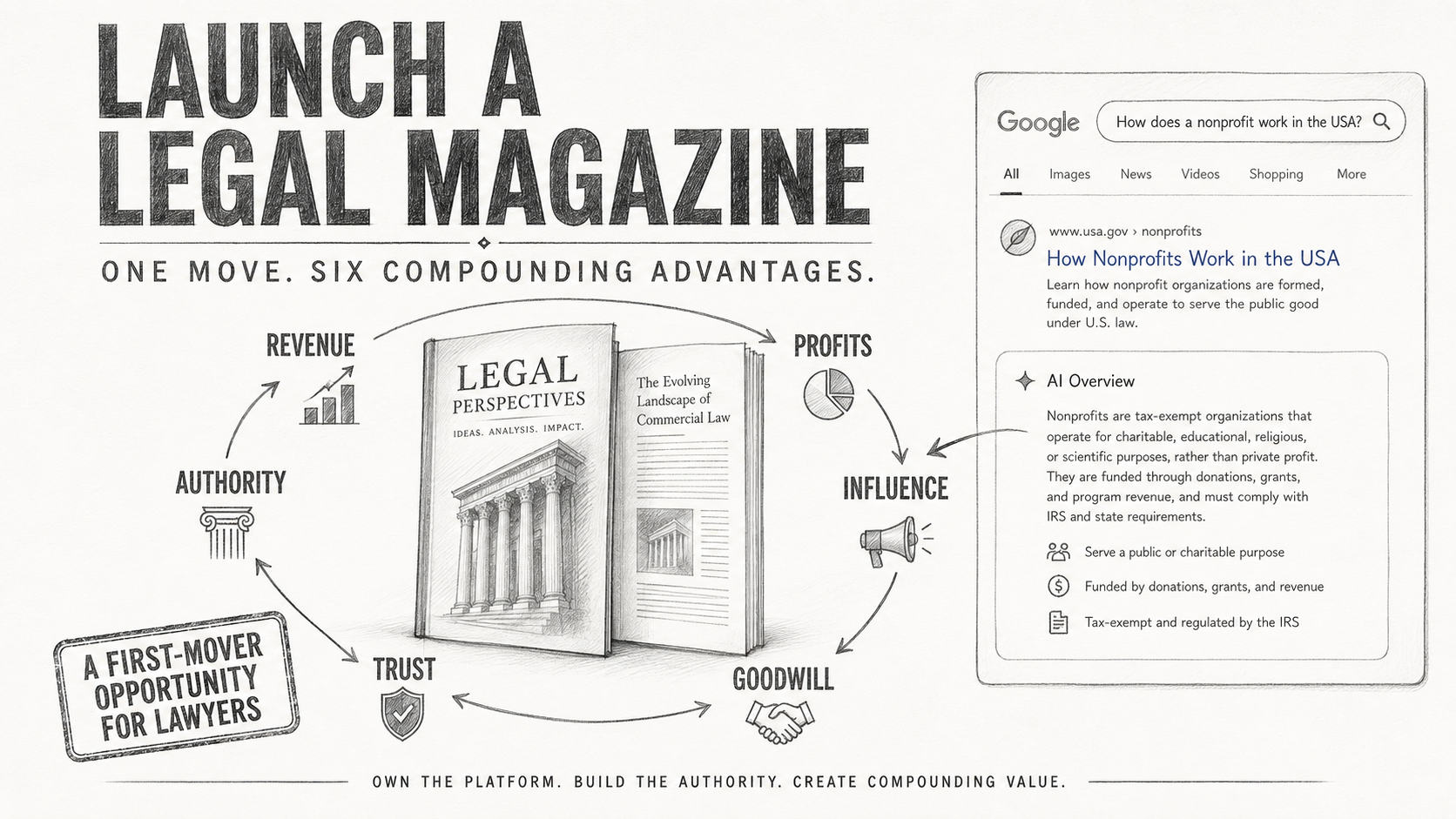
I have now come to believe that a legal magazine serves as a central, authoritative hub for comprehensive legal education. It’s the ultimate strategic asset for lawyers aiming to establish deep trust, expand their influence, and generate a vast repository of high-quality content that captivates both human audiences and advanced AI systems in today’s evolving landscape.
Consumers are not just searching for “best attorney near me” anymore – we’ve evolved beyond that. Consumers want information – lots and lots of it- before a call is booked, unless it is an emergency and you happen to pick up the call.
This guide does not cover law firm operating models that thrive on the “first to pick up the call” model – this is about building the go-to online resource hub that consumers, peers, and AI bots source their information from. It’s evolving from another lawyer on the block to the “source of knowledge and truth for humans and machines™”.
I’m starting to believe, through personal experience and experiments with clients, that a magazine can help professionals position themselves in a manner that they become the natural and obvious choice for someone ready to move forward, with every question answered, every variation covered, every “hidden” trap or gap exposed – they are convinced, ready-to-go, and just needed the right person who is trustworthy, licensed, and authentic in a market full of imposters, social media gurus, and “profit-focused” competitors. Stand out by building a double bottom-line law firm that focuses on revenue and public benefit (research, education, and consumer protection against imposters).
Key Takeaways
- Content is King, but Context is Crown: In 2026, generic content is penalized. A legal magazine allows for in-depth, nuanced exploration of legal topics, establishing unparalleled expertise.
- E-E-A-T is Non-Negotiable: Google’s Experience, Expertise, Authoritativeness, and Trustworthiness (E-E-A-T) framework is paramount, especially for “Your Money or Your Life” (YMYL) content like legal advice. A dedicated magazine demonstrably signals E-E-A-T.
- AI-Ready Content: With Google AI Overviews answering legal queries up to 78% of the time, content must be structured to be easily cited by AI, requiring clarity, depth, and original insights that a magazine format excels at.
- Long-Form Dominance: Long-form content (over 2,000 words) consistently outperforms shorter pieces in SEO, engagement, and establishing thought leadership, generating 37% more shares than shorter content.
- Strategic Content Repurposing: A single, comprehensive article from your magazine can be broken down into countless social media posts, webinars, and consultations, maximizing reach and efficiency.
- Separate Education from Services: By creating a standalone educational platform, you elevate your firm from a service provider to a trusted advisor, attracting higher-quality clients and more business.

Introduction: The Unseen Goldmine for Legal Innovators
I’ve spent my career navigating the intricate intersections of law, tax, finance, and increasingly, artificial intelligence. What I’ve consistently observed, and what becomes clearer every day in 2026, is that the legal profession is undergoing a profound transformation. The old playbooks for building authority, trust, and exposure simply aren’t enough. Many law firms are still running the same SEO strategies they were using a decade ago, which are now largely ineffective in a world dominated by AI-driven search and a demand for deep expertise.
I believe there’s an ultimate goldmine for lawyers looking to build true authority, trust, exposure, and a wealth of content: launching a dedicated legal magazine.
No, I’m not talking about a glossy print publication that gathers dust on coffee tables. I’m describing a dynamic, digital-first content hub-a standalone education center that serves as the nexus of your firm’s intellectual capital.
This isn’t just about publishing articles; it’s about systematically building a long-term real estate on Google, across AI platforms, and throughout social media. This is about establishing yourself, and your firm, as an undeniable thought leader – the obvious choice for someone ready to move forward with a real and licensed expert.
Think about it: Your firm is already doing incredible work, navigating complex legal nuances, busting consumer scams, and offering invaluable protection. You’re already investing your time, talent, and treasure to stand out. The crucial next step, in my view, is to consciously separate your education efforts from your direct service offerings.
Why? Because better education and research naturally lead to better clients and more business. It positions you not just as a lawyer, but as the definitive authority in your niche. By positioning your ideas, expertise, and insights in a stand-alone publication, you naturally stand-out in a market full of law firms that all sound the same.
Be different. Stand-out. Be top of mind. Answer what someone is searching for.
The digital landscape for legal marketing has grown immensely complex. Between Google’s evolving algorithms, the rise of AI-driven search results, and increasing client expectations, maintaining online visibility is no small feat. Static websites, generic content pages, and keyword-stuffed blogs are simply no longer enough to drive growth.
My goal today is to lay out a comprehensive, step-by-step roadmap for how a legal magazine can be your firm’s most powerful asset in this new era. This is not “hypothetical”; this is something we are experiencing on a daily basis with magazines in various niches, including several legal.
Step 1: Embracing the “Legal Magazine” as Your Content Command Center
What exactly do I mean by a “legal magazine”? I’m talking about a robust, online platform where hundreds – even thousands – of articles on all sorts of legal topics, frequently asked questions, scam prevention strategies, and intricate legal nuances reside. This platform serves as your primary publishing channel. All content is first published here, ensuring you own the original source (important for IP control), and then strategically distributed across various social media platforms, always linking back to your magazine. This creates a powerful, centralized content ecosystem.
The core philosophy here is to create a standalone education center. This isn’t just a blog tacked onto your firm’s website. It’s a dedicated knowledge base. This distinction is critical because it signals a profound commitment to educating your audience, free from the immediate pressure of selling services. This strategic separation allows your educational content to truly shine, attracting users who are genuinely seeking information and fostering trust long before they are ready to engage a lawyer.
Consider the data: 89% of law firms consider content “very important” to their overall marketing strategy in 2026. However, execution often lags, with only 27% of lawyers maintaining active blogs, and many firms leaving content stale for years. By committing to a magazine, you are intentionally choosing to lead the pack.
Step 2: Mastering Long-Form Content for 2026’s Digital Demands
In 2026, short-form content might grab attention, but long-form content is what builds trust, demonstrates authority, and secures lasting relationships. My friends, the internet is flooded with AI-generated snippets and content optimized for fleeting attention. This has created a “Depth Deficit” – a shortage of content that fully answers complex queries. For legal professionals, this isn’t a problem; it’s an immense opportunity.
A detailed article, a comprehensive guide, or an in-depth analysis from your legal magazine demonstrates your mastery of a topic and builds significant trust with your readers. In fact, long-form content, typically over 1,000 words, consistently outperforms for competitive, informational, and commercial queries. Articles exceeding 2,000 words rank in the top 3 results 53% more often than posts under 1,000 words, an advantage that has increased significantly since 2024. Content between 3,000-10,000 words generates 37% more shares than shorter pieces, with LinkedIn alone seeing a 19% rise in professional shares of in-depth articles.
This commitment to depth allows you to present nuanced arguments, cite evidence, acknowledge counterpoints, and showcase genuine expertise. A 3,000-word, research-backed article on an industry topic earns far more credibility and backlinks than dozens of short social posts. It also has a longer shelf life, driving traffic and leads for years.
Step 3: Optimizing for Google’s E-E-A-T and AI Overviews

This is where the rubber meets the road. Google’s E-E-A-T framework-Experience, Expertise, Authoritativeness, and Trustworthiness-is not just an SEO buzzword; it is the foundational algorithm that dictates whether your firm survives online, especially in 2026. Because legal services fall under the strict “Your Money or Your Life” (YMYL) category, Google demands absolute proof that your website will not cause financial or legal harm to its users. Generic legal fluff and thin content are mercilessly penalized by Google’s 2026 Core Updates.
Your legal magazine is tailor-made to meet these E-E-A-T standards. Every article can feature the attorney author, their professional credentials, and reflect real legal experience and insight, not just generic explanations. This first-hand experience is the newest and most under-implemented element of E-E-A-T. Content should include embedded redacted case outcomes, attorney narratives, and specific legal hurdles overcome, demonstrating genuine lived involvement.
Furthermore, AI is reshaping search. In 2026, legal queries trigger Google AI Overviews most frequently-around 78% of the time, according to SE Ranking research. This means your content needs to be optimized for AI summaries and citation. Structure your articles with clear headings, include FAQ sections, and write in a way that makes it easy for AI tools to extract key information. When ChatGPT, Perplexity, or Gemini generate an answer, they disproportionately cite sites that signal strong E-E-A-T.
Creating comprehensive, well-structured articles with clear answer blocks will make your content the reference layer that powers AI-generated answers. This also contributes to “Information Gain,” a crucial factor where Google rewards new information or perspectives not previously covered on a topic, moving beyond mere repetition of existing content.
Step 4: Leveraging SEO, Geo-Targeting, and AI for Maximum Visibility

A robust legal magazine fuels your entire digital presence. Here’s how:
Superior Google Search, Google AI, and AI Search Optimization
- Topical Authority: By publishing hundreds of in-depth articles on various legal topics, your magazine builds unparalleled topical authority, signaling to search engines that you are the go-to expert. Search engines reward comprehensive coverage.
- Keyword Opportunities: Long-form content naturally covers related terms, questions, and subtopics, giving you more surface area for rankings. You can research high-intent legal keywords and optimize dedicated practice area pages, each flowing from your magazine’s deep content.
- Technical SEO: While content is king, technical SEO is the foundation. Ensure your magazine platform has fast mobile page speed (under 3 seconds), proper schema markup (LegalService, Attorney, FAQ), a secure HTTPS site, and a clean URL structure. Google measures trust by analyzing user friction, so a slow site is a negative trust signal.
- Backlinks: High-quality, authoritative content from your magazine naturally attracts backlinks from other reputable sites, legal directories (Avvo, Justia, Super Lawyers), and bar associations-a crucial ranking signal for legal SEO. Digital PR, the strategic use of third-party media, can help get your firm featured on high-authority websites and news outlets, earning valuable backlinks.
Geo-Targeting for Local Dominance
Most clients search for legal services nearby, and Google prioritizes local results. Your magazine’s content can be leveraged for hyper-local SEO by creating local landing pages if you serve multiple cities, and ensuring your Google Business Profile is fully optimized. Optimizing for local search results is something you absolutely do not want to miss. For example, 93% of the time, Google’s local pack shows up before regular search results for local search intent, and firms in local packs can get about 44% of user clicks.
AI Readability and Citation
As I’ve touched upon, AI is consuming thought leadership content at a scale no human audience ever could. These systems evaluate your expertise, rank your authority, summarize your insights, and decide if your name and perspective should appear when someone asks an AI platform for legal information. By producing structured, comprehensive content that demonstrates E-E-A-T, your legal magazine becomes a preferred source for AI systems.
Step 5: Maximizing Reach Through Strategic Content Distribution
Once your rich, authoritative content is published on your legal magazine, the next step is strategic distribution. This is about maximizing the value of every piece you create.
Social Media as a Distribution Channel
While organic social media traffic is increasingly competitive, social platforms remain vital for brand awareness, engagement, and content distribution. The key in 2026 is quality over quantity. Instead of posting generic updates, share compelling insights directly from your magazine articles. Focus on platforms where your target clients are most active:
- LinkedIn: The undisputed leader for B2B engagement and professional networking. Share insightful takes on new laws, case decisions, and practice area developments, all linking back to your in-depth magazine articles.
- Facebook: Ideal for engaging the general public, especially for consumer-facing practice areas like family law or personal injury. Post client success stories, educational live streams, and FAQs, again, drawing from your magazine.
Imagine this: Many lawyers have 3,000-6,000 social media posts across various platforms. Imagine if even half of those were direct snippets or discussions inspired by articles from your legal magazine. You’d have thousands of articles on all sorts of topics, creating an amazing feedback loop for SEO, geo-targeting, AI visibility, and human engagement.
Repurposing and Multi-Channel Engagement
A single, in-depth article from your magazine is a goldmine for repurposing:
- Turn key sections into infographics for visual platforms.
- Extract compelling quotes for social media carousels.
- Develop webinars or online calls based on complex topics covered.
- Use article outlines as scripts for educational videos.
This approach means every piece of long-form content you create isn’t a one-off effort but a foundational asset that generates multiple touchpoints across your digital ecosystem.
Step 6: Cultivating Client Relationships and Business Growth
The entire purpose of this comprehensive content strategy is to cultivate deeper client relationships and drive sustainable business growth. From your legal magazine, several natural pathways to client engagement emerge:
- Intake Forms and Surveys: Integrate forms that allow readers to ask specific questions related to an article, providing warm leads.
- Webinars and Online Consultations: Offer deeper dives into complex topics discussed in your magazine, leading to direct engagement.
- Client Referrals: By establishing yourself as a leading authority, other professionals will naturally refer clients to you.
- Enhanced Trust and Credibility: Prospective clients in 2026 pre-vet lawyers harder than almost any other service. They search firm names, scan reviews, and form opinions quickly. Your magazine, filled with authoritative content, fills that first page with credibility that competitors cannot manufacture.
The visitor-to-lead conversion rate across law firms is approximately 7.4%, but content marketing is best for long-term nurture and repeat business. By consistently providing value through your magazine, you’re not just chasing leads; you’re building a community of informed, trusting potential clients.
Action Items for Your Legal Magazine Launch
- Define Your Niche: While a broad magazine is powerful, start by identifying specific practice areas or client problems where your firm has unparalleled expertise.
- Platform Selection: Choose a robust, SEO-friendly content management system (CMS) that can scale with hundreds of articles. Consider a subdomain (e.g., magazine.yourfirm.com) for clear separation from your main service site.
- Content Calendar Creation: Develop a strategic content plan, outlining key topics, target keywords, and article formats (e.g., guides, Q&As, case analyses). Prioritize long-form content that targets complex, high-intent queries.
- Author Attribution: Ensure every article is clearly attributed to an attorney with detailed bios, credentials, and real-world experience to boost E-E-A-T.
- AI Optimization Checklist: Implement a checklist for every article to ensure it is structured for AI readability: clear headings, concise summaries, FAQ sections, and unique insights.
- Distribution Strategy: Map out your social media and other distribution channels, ensuring every piece of content published on your magazine is effectively promoted and linked back to its original source.
- Performance Measurement: Set up analytics to track engagement, organic traffic, social shares, and conversion pathways from your magazine.
Conclusion: The Future of Legal Authority is Built, Not Bought
Folks, the legal landscape of 2026 demands a proactive, sophisticated approach to digital presence. The days of simply having a website and basic SEO are long gone. What’s truly effective is building a defensible, authoritative digital footprint that resonates with both human intellect and the increasingly intelligent algorithms that govern online discovery.
A legal magazine, conceptualized as a modern, digital education center, is not merely a marketing tactic. It’s a strategic investment in your firm’s future. It’s how you transcend transactional relationships and become an indispensable resource, a trusted advisor, and an undeniable thought leader in your field. By dedicating ourselves to providing genuine, comprehensive value through such a platform, we not only attract better clients but also shape the very conversation around legal issues, standing out in an increasingly crowded digital world.
This isn’t just about adapting to change; it’s about leading it. I invite you to consider how a legal magazine can transform your practice, build enduring authority, and cement your legacy as an innovator in the law.
I’d love to hear from you – share your comments on thoughts below.
Cheers,
Sid Peddinti
References
- Why Long-Form Content is Your Best Marketing Ally in 2026 – Calaméo Blog
- SEO for Lawyers and Attorneys: Complete 2026 Guide – Promodo
- Best Law Firm SEO Strategies in 2026 (With AI Tools) – Eve Legal
- Law firm social media marketing: complete guide (2026) – Birdeye
- SEO for Lawyers: The Ultimate Guide to Law Firm SEO in 2026 – Esquire Interactive
- Long Form vs Short Form Content: What’s Best in 2026 – Devenup Blog
- Google Updates in 2026: What Law Firms Need to Know to Stay Visible in Search –
- How High-Performing Law Firms Are Using AI in 2026 (Without Replacing Attorneys)
- Thought Leadership Strategy for Law Firms: How to Build Authority and Attract Clients
- Digital PR for Law Firms | 2026 Strategy – Subscribe PR
- The Ultimate Guide to SEO for Law Firms in 2026 – Inovista Blog
- Why long-form content is a ranking advantage in 2026 – Trone
- AI-Generated Content for Law Firms: The Pros, Cons, and What You Need to Know in 2026 –
- SEO for Lawyers: The 2026 Guide to Law Firm Search Engine Optimization
- Effective Law Firm Web Marketing Strategies in 2026 – Levitate
- Social Media for Lawyers: The Complete 2026 Guide – Turner Digital Solutions
- Demystifying Google’s E-E-A-T for Lawyers: How to Prove Your Legal Authority in 2026 – Blue Media Marketing Law
- E-E-A-T in 2026: Experience, Expertise, Authority & Trust for Google AND AI Search – OptiSEOn
- TOP 10 LONG-FORM CONTENT MARKETING STATISTICS 2026 REVEAL SHOCKING CONTENT DOMINATION TRENDS
- 2026 Legal Marketing Trends You Should Already Be Using
- AI in the Legal Industry: 2026 Use Cases, Risks and Trends for Law Firms
- What legal professionals say about the role of AI and law in 2026 – Thomson Reuters
- Supercharge Your Networking with Social Media: A Lawyer’s Guide (2026 Update) –
- Law firm marketing statistics for 2026: A comprehensive analysis – Revenue Memo
- The New AI Regulations That Will Impact Your Legal Team – Ironclad
- Is long-form content still important in 2026? – Embryo
- Google E-E-A-T in 2026: How Experience, Expertise, and Trust Drive SEO Success –
- Thought Leadership in 2026: Strategies That Actually Build Influence – Ivy Exec
- Google E-E-A-T Guidelines: an Overview (2026 Playbook) – Keywords Everywhere Blog
- Digital PR Services for Law Firms – 9Sail
- Top 40+ Law Firm Marketing Statistics for 2026 – MyCase
- Legal Operations Thought Leadership – UpLevel Ops
- The 2026 Law Firm Marketing Benchmarks: Where Your Firm Actually Stands – Pioneerly
- The 2026 Strategic Playbook for Legal Leaders
- Why Your Law Firm Needs a Digital Marketing Agency in 2026 – PaperStreet Web Design
- Digital Marketing for Law Firms 2026: Attract Clients – SocialJack Media
- Legal Marketing Statistics 2026 – Pareto Legal
- Law Firm Link Building Agencies 2026 – Web Tonic™
- 92 Legal Marketing Statistics for 2026 – SeoProfy
- The Fundamental Shift In Thought Leadership That Attorneys and Legal Execs Can’t Ignore

Leave a Reply