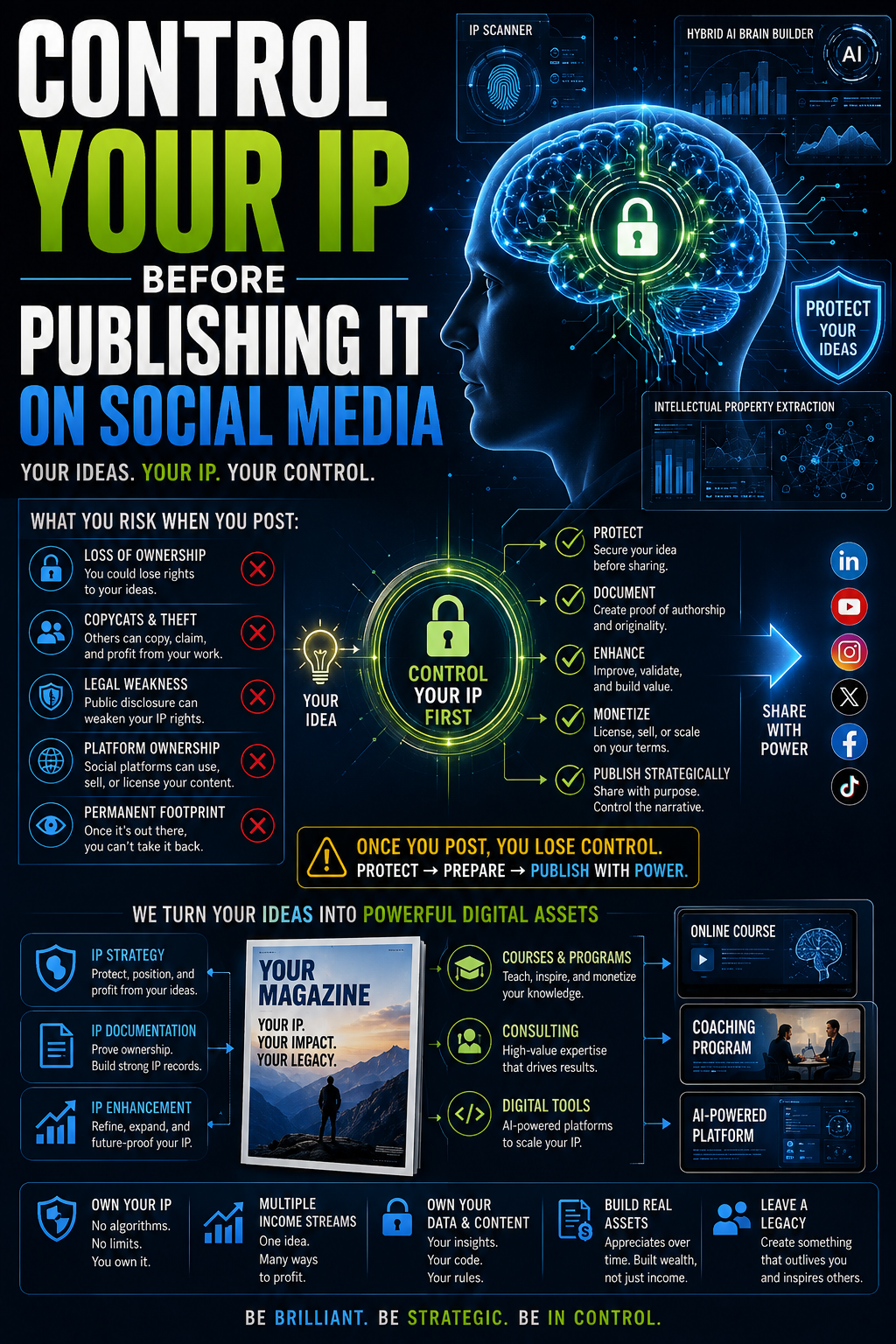
This article explores the “PESO Media: Paid vs Earned vs Shared vs Owned” framework, why business owners should understand “first-publishing-rights”, the terms and conditions of social platforms, and how a magazine can be used to protect their ideas and IP before it gets shared on social media.
By Sid Peddinti – Lawyer, Publisher, Nonprofit Board Advisor, and Ghostwriter
Image created by Start A Magazine AI-Editorial Teams. All screenshots, text excerpts, and referenced materials from LinkedIn, Meta, and TikTok are the intellectual property of their respective owners. Used here under Fair Use for purposes of commentary, education, criticism, and analysis. All rights belong to their original creators.
Hello friends,
I hope you are well. In this article, we want to explore various types of media, the terms and conditions of social media platforms you have agreed to, and how to protect your original ideas before you share them on social media platforms.
Most business owners and creators believe they own their social media accounts and profiles. They believe that because they spend eight hours a day posting on LinkedIn, filming for TikTok, or building a following on Instagram, they are building “owned” assets. Businesses even sell their accounts when they exit a company – blurring the lines between owned and rented media assets.
The reality is much harsher. Most businesses are currently building their houses on rented land.
This master guide breaks down the traditional PESO model (Paid, Earned, Shared, Owned), identifies exactly where social media fits, and—most importantly—reveals how to pivot your strategy to ensure you aren’t at the mercy of a single algorithm update or a sudden account ban.
⚡ Key Takeaways
- Social Media is “Shared” Media: While it has elements of owned and paid, you do not own the platform, the data, or the relationship with your audience.
- The Rented Land Risk: Relying solely on social media platforms means your business can be disrupted overnight by bans or algorithm shifts.
- IP Control: To truly protect your intellectual property, you must publish first on an independent platform (your own magazine/publication) before sharing to social channels.
- The Strategy Shift: Use social media as a distribution engine, not a storage locker. Every post should lead back to a central hub you control.
- Diversified Distribution: Leverage modern tools (like WordPress cross-sharing) to push content to multiple niche accounts, reducing the risk of a “single point of failure.”
Table of Contents
- The Traditional Media Framework: Understanding PESO
- Where Social Media Fits: The Convergence Crisis
- The Myth of “Owned” Social Media Profiles
- The Risks of the “Social-First” Strategy
- How to Control Your IP and Data When Using Social Media Platforms
- How to Ensure Your Business is Not at the Mercy of Social Media Platforms
- Building Your Independent Publication: The Solution
- The New WordPress Workflow: Multi-Platform Synergy
- Comparative Analysis: Owned vs. Shared Assets
- Frequently Asked Questions (FAQ)
- Call To Action & Next Steps
The Traditional Media Framework: Understanding PESO (paid, earned, shared, and owned)
For decades, marketers have used the PESO model to categorize where content lives and how it spreads. To understand where social media fits, we have to define the four pillars clearly.
Paid Media
Paid media is “rented” attention. You pay for space on a platform to reach a specific audience. This includes Google Ads, Facebook Ads, and sponsored content. It provides immediate reach but stops working the moment you stop paying.
Earned Media
This is the digital equivalent of word-of-mouth. It is content created by others about your brand. Examples include press coverage, organic reviews on third-party sites, and mentions by influencers who weren’t paid to speak about you. It is high-trust but low-control.
Shared Media
Shared media is the primary home of social platforms. It is defined by collaboration and community interaction. While you “own” the profile, the platform owns the environment. Your content’s success depends on the platform’s algorithm and how users engage (likes, shares, comments).
Owned Media
Owned media consists of any channel or platform that your business has total control over. This includes your website, your blog, your proprietary email list, and your mobile apps. You decide the rules, you own the data, and no third party can “turn off” your access to your audience without a legal battle or a breach of contract on your end.
Where Social Media Fits: The Convergence Crisis
Social media is unique because it doesn’t stay in one box. It is a chameleon that functions across all four categories depending on your tactical application.
- As Shared Media: This is the core. When you post a video and someone shares it, you are benefiting from the viral nature of shared media.
- As Owned Media (The Illusion): Your brand’s profile—the grid, the bio, the uploaded photos—looks like owned media. You customize the branding and the messaging. However, this is “Soft Owned” media. You have the right to use it, but you don’t own the “dirt” it’s built on.
- As Paid Media: Using “Boosted Posts” or the Meta Ads Manager turns the social platform into a paid media channel.
- As Earned Media: When a user tags your law firm in a post about a successful case, or a financial influencer mentions your advisory services, social media becomes a powerful earned media engine.
The danger lies in Convergence. Because social media does all four, many businesses stop investing in their actual owned platforms, thinking their Instagram or LinkedIn is “enough.”
The Myth of “Owned” Social Media Profiles
People believe that because they created the content, they own the “page.” This is a dangerous myth. They don’t own the social media accounts. It’s like a billboard sign on the highway – you can advertise on it, but you don’t own the board.
When you sign the Terms of Service for any social platform, you are entering into a licensing agreement. You generally retain the copyright to your original content, but you grant the platform a “perpetual, royalty-free, transferable, sub-licensable, worldwide license” to use that content.
More importantly, the digital platform itself—the followers, the keywords, the indexing, and the derivative data created by your audience’s behavior—does not belong to you. If the platform decides to launch a competing product or service based on the trends they identified from your “published content,” you are not entitled to a single cent in royalties.
The Risks of the “Social-First” Strategy
If your business relies primarily on social media for client acquisition and brand awareness, you are operating with several “Single Points of Failure.”
1. The Algorithm Tax
You are relying on constant changes to the algorithms. A single tweak in how “reach” is calculated can slash your business leads by 50% overnight. You are essentially “renting” your original content back from the platform; even though you made it, you often have to pay for “Boosts” just to show it to the followers you already earned.
2. The Ban Hammer
Accounts are banned every day without warning. Whether it’s an automated bot mistake, a malicious report from a competitor, or a sudden change in “Community Guidelines,” your entire business presence can be wiped out in seconds. There is rarely a “customer service” line to call for an immediate fix.
3. The Ad Dependency
If your ads stop working—or if the platform increases the cost-per-click beyond your profit margins—your business model breaks. Without an owned platform to capture that traffic and convert it over time, you are stuck on a treadmill of spending.
How to Control Your IP and Data When Using Social Media Platforms
To truly protect your intellectual property (IP), you must change the order of operations. Currently, most people create a post inside the social media app. This is a mistake.
The “Publish First” Protocol:
- Draft on Your Domain: Write your article, scenario, or case study on your own stand-alone publication (your magazine or website).
- Establish First Rights: By publishing on your site first, you establish a timestamped, original version of that IP on a platform you own.
- Use Social as a Snippet: Post a “hook” or a snippet on social media that leads back to the full article.
- Ownership of Derivative Works: By keeping the master copy on your site, you ensure that any SEO value (keywords, backlinks) accrues to your domain, not just the social platform’s servers.
This is how to control your IP and data when using social media platforms: Treat them as traffic lights, not destinations.
How to Ensure Your Business is Not at the Mercy of Social Media Platforms
The secret to resilience is decoupling your brand from the platform’s volatility. You do this by building a library.
Most professional firms (law, finance, consulting) use one main account under their business name. If that account gets flagged, everything stops. Instead, consider this more robust architecture:
- Build a Stand-Alone Magazine: Create a publication that covers various topics, cases, and scenarios. This is your independent platform.
- The Library Effect: Instead of 100 random social posts that disappear into the “feed,” you build a library of 100s of articles with all sorts of nuances. This library is searchable, indexable by Google, and belongs to you forever.
- Segmented Distribution: Use different social accounts to target different audience categories. If one account faces a shadowban or an algorithm dip, your other channels—and your central publication—remain unaffected.
Building Your Independent Publication: The Solution
Why a magazine format? Because a magazine implies authority, depth, and variety. It allows you to talk about interconnected topics that might feel “off-brand” on a rigid corporate social media page.
In your own publication, you can cover:
- Case Studies: Detailed breakdowns of real-life work you have handled.
- Scenario Planning: “What if” situations that demonstrate your expertise.
- Niche Questions: Addressing the long-tail questions that potential clients actually type into Google.
By housing these on your own platform, you are not just “posting”; you are building a digital asset that increases the valuation of your business.
The New WordPress Workflow: Multi-Platform Synergy
One of the most powerful recent developments for WordPress users is the enhanced ability to share articles across many platforms and many pages simultaneously. This is the technical “moat” your business needs.
How it works:
- Central Hub: You write one high-quality master article in your publication.
- Targeted Sharing: You can choose which snippets are shared to which specific social accounts.
- Audience Segmentation: You can build multiple audience segments (e.g., a “Small Business” segment on one page and a “High Net Worth” segment on another) all fed by the same central publication.
- Ad Integration: Run ads directly to the social posts that contain buttons leading back to your magazine.
If a social media platform decides to launch a competing technology derived from “published content,” they are scraping your shared snippets, but they don’t own the source—your magazine. You control the flow of traffic.
Comparative Analysis: Owned vs. Shared Assets
| Feature | Owned Media (Your Magazine) | Shared Media (Social Platforms) |
|---|---|---|
| Control | Total control over content and layout. | Subject to platform rules/GUI. |
| Data Ownership | You own all user data and analytics. | Platform keeps the most valuable data. |
| Stability | Cannot be “banned” (unless you violate hosting). | Can be banned or suspended instantly. |
| Algorithm Risk | Zero. You control the delivery. | High. Algorithms change constantly. |
| IP Protection | You own first publishing rights & trademarks. | You license your IP to the platform. |
| Longevity | Content is evergreen and searchable. | Content has a shelf life of hours/days. |
| Monetization | 100% yours (or via your chosen ads). | Platform takes a cut or shows competing ads. |
Frequently Asked Questions (FAQ)
What is the biggest mistake businesses make with social media?
Treating social media as a storage unit for their best ideas. If you put your best “Trade Secrets” or unique perspectives directly into a LinkedIn post without a link back to your site, you are giving away your IP for a few temporary “likes.”
Can I still use social media if I want to “own” my media?
Yes, and you should. But you must use it as a distribution channel. Think of social media like a newsstand. You wouldn’t put your entire magazine out for free on the sidewalk; you put the cover and a few headlines out to entice people to buy the whole magazine and come into your store.
How do I start “owning” my content if I’m already on social media?
Start by auditing your most successful social posts. Turn those into long-form articles on your own website. From now on, every time you have a “great idea” for a post, write it on your blog first, then share the link.
Is it really possible for my account to be banned for no reason?
Absolutely. Automated moderation systems use AI to detect “policy violations.” These systems often flag content incorrectly. Reclaiming an account can take months, during which time your business could lose thousands in revenue.
How does having my own publication help with SEO?
Google AI Overviews and search rankings prioritize authoritative, original content on dedicated domains. Social media posts are often walled off or have “no-follow” links. A central magazine allows you to capture “organic” search traffic that social media cannot reach.
The Next Steps
The era of relying on “Rented Land” is coming to an end for savvy professionals. To protect your business, you must transition from being a “Content Creator” for social platforms to being a Publisher of your own IP.
Your Action Plan:
- Audit your IP: Identify your best insights and move them to a domain you own.
- Launch Your Magazine: Use a platform like WordPress to create a stand-alone publication that you control.
- Diversify Your Channels: Set up multiple social accounts to share your work, ensuring no single platform holds the keys to your success.
- Control the Flow: Always lead users back to your own environment where you own the data and the conversion path.
Stop renting. Start owning.
Thanks for reading,
Sid Peddinti, Esq.
Lawyer, Researcher, Publisher, AI Innovator
References & Sources
- The PESO Model: A Framework for Integrated Communications by Gini Dietrich.
- Terms of Service Data: A Comparative Study of Social Media Licensing Agreements.
- The Impact of Algorithm Volatility on Small Business Revenue: 2023 Digital Marketing Report.
- Google Search Central: Creating Helpful, Reliable, People-First Content.
- WordPress Foundation: Cross-Platform Distribution and API Integration Documentation.

Leave a Reply