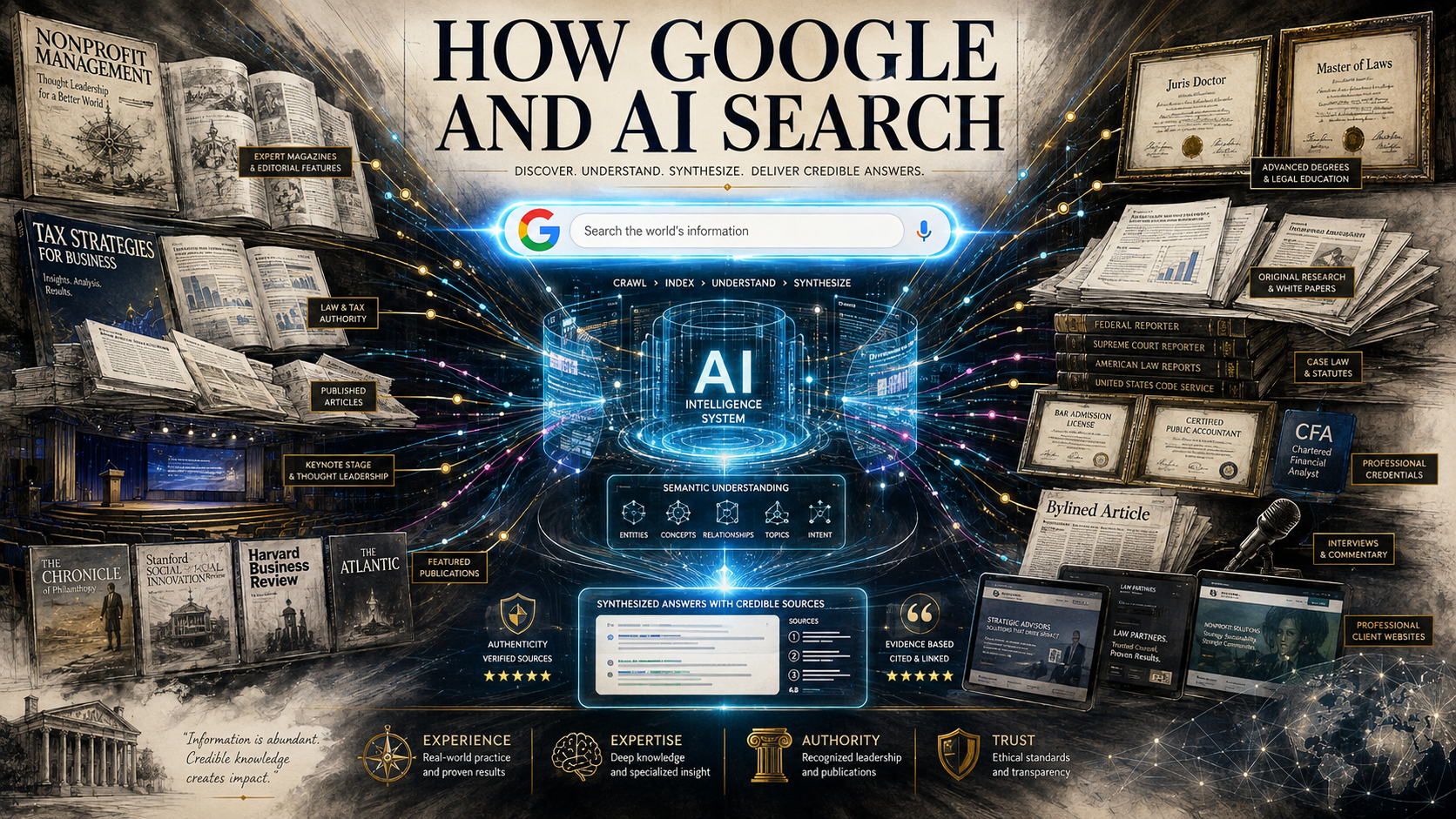
This article examines the inner workings of how AI platforms and search algorithms operate in 2026
By: Sid Peddinti, Esq.
Lawyer, Researcher, AI Innovator, Publisher, and Ghostwriter.
Executive Table of Contents
- The Death of the Passive Professional: Why 2026 Demands Authority Architecture
- The 2026 Search Paradigm: From Google Links to AI References
- The Anatomy of the Authority Stack: Credentials, Research, and Owned Assets
- Niche Blueprints: Playbooks for Lawyers, Physicians, Financial Advisors, and Consultants
- Engineering for the Algorithm: Securing Your Spot in Google AI Overviews (SGE)
- The Preeminence Imperative: Why You Must Own Your Publication Platform
- References & Primary Sources
1. Why Building And Showcasing Authority Is Important In 2026
In the professional landscape of 2026, the traditional resume is no longer a static document-it is a living, breathing digital ecosystem. For the high-level attorney, the specialized physician, or the foundation executive, “being online” is no longer enough. The digital world has shifted from a directory of names to a competitive arena of verified expertise. We have entered the era of the Sovereign Professional, where authority is not granted by a title alone but architected through a strategic “Authority Stack.”
As we navigate this mid-decade shift, professionals face a paradox. While the barrier to entry for content creation has vanished thanks to generative AI, the barrier to earning genuine trust has never been higher. Search Engine Journal’s 2026 survey of over 370 SEO professionals reveals a staggering reality: zero-click searches now dominate over 60% of Google queries. This means that if you are not the primary source-the one the AI chooses to cite-you are effectively invisible. To remain relevant, creators and authors in the professional space must move beyond “content” and toward “preeminence.”
This article serves as the definitive guide for professionals looking to build an unshakeable foundation of authority, trust, and credibility. By the end of this exploration, you will understand how to construct an Authority Stack that satisfies both human scrutiny and the increasingly sophisticated algorithms of Google Search and AI Overviews.
“In 2026, authority is the only currency that isn’t devalued by AI. If you aren’t the source, you’re just noise.” – Senior Strategist at AuthorityTech
2. The 2026 Search Algorithms: From Google Links to AI References
The rules of the game changed in early 2026 when Google made AI Overviews (formerly SGE) the default experience for all logged-in users. This shift represents a structural transformation in how information is consumed. Traditional blue-link SEO, which once drove the majority of professional leads, has seen a 15% to 30% decline in organic click-through rates. However, the data suggests a silver lining: visitors who arrive via AI-cited results convert 42% better and spend 48% more time on-site than traditional searchers.
For professionals, this means the goal is no longer to “rank number one.” The goal is to be the “Consensus Source.” Google’s 2026 algorithm favors a consensus-based citation model, where the AI synthesizes information from three to eight high-authority sources. If your digital magazine or author profile is not within that elite circle, your expertise is essentially omitted from the AI’s answer. To be cited, your content must be structured, factual, and deeply rooted in E-E-A-T (Experience, Expertise, Authoritativeness, and Trustworthiness).
The Rise of Author Expertise as a Hard Signal
One of the most critical updates in March 2026 was the requirement for explicit author attribution. Google’s systems now prioritize content that includes a verified author name, title, and a linked, comprehensive bio. Content with these “hard signals” is four times more likely to be cited in an AI Overview than anonymous or brand-only content. This is why building an author-centric brand is paramount for lawyers, consultants, and speakers.
3. The Anatomy of the Authority Stack: Credentials, Research, and Owned Assets
The Authority Stack is a multi-layered framework designed to establish a professional as the definitive voice in their niche. It moves beyond a simple blog and creates a robust portfolio of evidence that AI models and human clients can easily verify.
1. The Foundation: Credentials and Clinical Evidence
In 2026, credentials must be more than just letters after a name. They must be digitally verified and linked to the organizations that issued them. For physicians and lawyers, this involves ensuring that their profiles on state bar associations or medical boards are updated and cross-linked with their personal and professional platforms. Google uses these external links as “Trust Anchors” to verify that the person claiming expertise is indeed qualified.
2. The Core: Owned Digital Real Estate
Social media is “rented land.” In 2026, professionals have learned the hard way that platform algorithms can change overnight, erasing years of audience building. The Authority Stack requires “Owned Digital Real Estate”-specifically, a digital magazine or high-authority publication platform. By owning the platform, you control the IP, the user data, and the technical structure that feeds Google’s AI. A dedicated magazine platform allows for the hosting of long-form guides, white papers, and original research that serves as the “source of truth” for the industry.
3. The Catalyst: Original Research and Case Studies
Generic content is the enemy of authority. To stand out, professionals must publish original data, unique case studies, and proprietary research. In the legal and financial sectors, a well-documented case study that details a complex problem-solving process (without violating confidentiality) serves as “Information Gain” content. Google’s AI models are specifically tuned to reward “new” information that isn’t already in the training set. If you are the only one providing a specific statistic or insight, you become the mandatory citation.
4. The Flywheel: Interviews and Contributor Roles
Authority is also established by who you know and who cites you. A professional’s stack should include a regular rhythm of interviews on high-authority podcasts and guest contributions to respected industry journals. Each mention acts as a digital endorsement. In 2026, “Digital PR” is less about hype and more about creating a web of authoritative mentions that the AI can use to triangulate your reputation.
4. Niche Blueprints: Playbooks for High-Stakes Professionals
The implementation of the Authority Stack varies by industry. Below are specific strategic playbooks for different professional domains in the 2026 landscape.
1. Lawyers: Defending the Narrative
For attorneys, authority is synonymous with “Precedential Thought Leadership.” In 2026, the most successful firms are moving away from “Personal Injury 101” articles and toward deep-dive analysis of emerging regulations.
- Strategy: Launch a digital “Legal Review” magazine. Publish monthly briefs on how recent court rulings affect specific client industries (e.g., “The Impact of 2026 AI Liability Rulings on Mid-Sized Manufacturers”).
- Trust Signal: Ensure all articles are tagged with Schema (org) “LegalService” markup and include links to the attorney’s bar profile, credentials, and/or successful case citations.
2. Financial Advisors: Trust in the Wealth Gap
With an estimated $124 trillion in US wealth transferring through 2048, financial advisors are competing for the next generation of investors. These investors are “Digital Natives” who verify everything through AI.
- Strategy: Build an authority stack centered on “Wealth Longevity Research.” Create interactive reports and white papers on tax-advantaged wealth transfer in the 2026 economic climate.
- Trust Signal: Leverage “Verified Financial Reviewer” badges and ensure all financial advice content is reviewed by a CFP-credentialed author to satisfy YMYL (Your Money or Your Life) standards.
3. Physicians and Dentists: Clinical Credibility in YMYL
Healthcare SEO is under the most rigorous scrutiny. Google’s 2026 algorithm updates have raised the bar for “Clinical Experience” signals.
- Strategy: Transition from service-based marketing to “Patient Outcomes Education.” Host a digital publication that features interviews with specialists and deep dives into treatment nuances (e.g., “What 20 Years of Implantology Has Taught Me About Bone Density”).
- Trust Signal: Every medical article must include a “Medically Reviewed By” line with a link to the reviewer’s credentials. Video transcripts of the doctor explaining procedures provide “Experience” signals that AI models prioritize.
4. Consultants, Nonprofits, and Foundation Executives
For these leaders, authority is about “Category Command.” They must be seen as the visionary at the center of their movement or industry.
- Strategy: Create an “Industry Outlook” magazine. Instead of talking about what you do, talk about where the industry is going. Publish annual “State of the Sector” reports.
- Trust Signal: Focus on “Entity-based SEO.” Ensure your name is consistently associated with key industry terms across various high-authority platforms.
5. Engineering for the Algorithm: Securing Your Spot in Google AI Overviews (SGE)
To ensure your Authority Stack is actually indexed and cited by Google’s AI in 2026, you must adhere to several technical and structural mandates:
- Direct-Answer Structure: AI Overviews are designed to extract answers. Lead your articles with a concise, factual summary (40-60 words) that directly answers the primary question of the piece.
- Semantic Depth: Use “Topic Clusters” rather than single keywords. Instead of just “How to build authority,” your platform should cover “Digital credential verification,” “AI citation optimization,” and “E-E-A-T for professionals.”
- Multimedia Integration: In 2026, video is a primary citation source. Include short, captioned videos on every major page. Google’s AI analyzes these transcripts to verify the “Experience” component of E-E-A-T.
- Schema Markup: Implement FAQ, HowTo, and Person schema. This “structured data” is the language Google’s AI uses to understand the context of your content.
6. Gain Preeminence In Your Industry: Why You Must Own Your Publication Platform
The evidence in 2026 is undeniable: the era of the “fatigued blog” is over. Professionals who continue to rely on social media platforms or third-party sites are renting their authority on borrowed time. When you post on LinkedIn or Medium, you are handing over your most valuable intellectual property to an algorithm that does not prioritize your long-term brand preeminence. You lose control of the data, you lose the technical SEO advantage, and you lose the ability to be the primary source for Google’s AI Overview.
To achieve true category preeminence, you must launch your own digital magazine platform. This is the only way to secure “First-Publishing Rights” and establish the “Information Gain” that Google’s 2026 algorithm demands. By owning your platform, you create a “Sovereign Authority” that cannot be de-platformed or overshadowed by competitors who are simply “creating content” on social media.
However, we understand that for a busy lawyer, CPA, or physician, the prospect of learning investigative journalism and the complexities of 2026 AI-SEO is daunting. This is not a skill that even skilled wordsmiths, lawyers, do not inheritly possess -there’s an art and a science to it, just like anything technical.
This is where strategic partnership becomes your greatest leverage. By partnering with our elite ghostwriting and AI research team at Start A Magazine, you bypass the $30,000 to $50,000 investment and years of trial-and-error normally required to master these disciplines. We provide the infrastructure, the journalistic rigor, and the technical SGE optimization to ensure your voice is the one cited by Google.
You get to appear as the Featured Legal Expert, Featured Financial Expert, or whatever is relevant in your category – while we handle the research, writing, and publication piece of it.
Do not leave your authority to chance. Bad actors are stepping in and posing to be licensed professionals – because there is a gap and it needs to be filled.
Partner with Start A Magazine today and claim your rightful place at the top of the Authority Stack.
7. References & Primary Sources
- Google Cloud Blog: 2026 M-Trends Report and Beyond: Key Findings in the Public Sector – July 2026
- AuthorityTech: Google AI Overviews Impact on SEO 2026: Peer-Reviewed Data – May 2026
- Traffic Torch: State of SEO & GEO in 2026: In-Depth Industry Report – March 2026
- Thomson Reuters Institute: 2026 Report on the State of the US Legal Market – January 2026
- Cerulli Associates / CoinLaw: Financial Advisor Statistics 2026: AUM and Headcount Trends – May 2026
- Baden Bower Research: State of Earned Media vs. Paid Media 2026 Annual Report – May 2026

Leave a Reply